Georges Pontmercy
Les MisérablesGeorges Pontmercy is a Napoleonic veteran whose military service and political convictions survive him chiefly through a final letter to his son, Marius. Estranged from Marius by the royalist household that raised the boy, he dies before their relationship can be repaired. His last message leaves Marius a contested title and a duty of gratitude, turning a barely known father into a posthumous force in his son’s life.
Identity and Family Separation
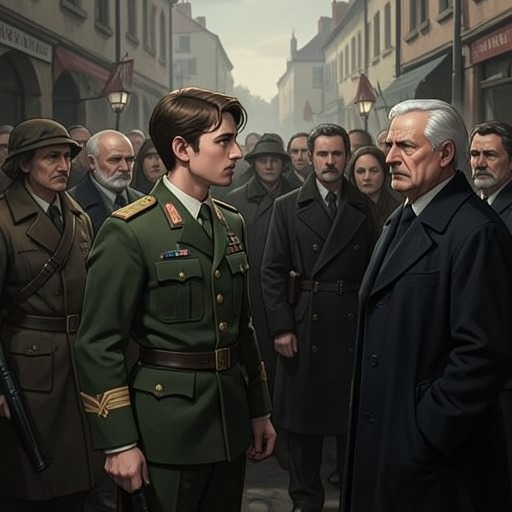
Georges Pontmercy was the son-in-law of M. Gillenormand and the father of Marius. He had married a young woman from a prominent bourgeois family. After her death, her father took Marius away from Georges and raised him according to his own principles. M. Gillenormand was a fervent royalist, hostile to the ideas of his son-in-law; the separation therefore divided father and son not only by household but also by political allegiance. Marius grew up apart from Georges and did not develop love for him.
Georges had been a hero of the Empire. Napoléon Ier made him a colonel and a baron, but Louis XVIII denied him those titles after the Restoration. The distinction between the military honor he had won and the recognition withheld from him remained central to his understanding of what he could pass on to Marius. His claim to the barony was not merely a family ornament: in his letter, he insisted that he had paid for it with his blood and that his son should take it up and prove worthy of it.
Illness and Death at Vernon
Georges had been ill with a cerebral fever for three days. At the beginning of the illness, troubled by a foreboding, he wrote to M. Gillenormand asking for Marius. As his condition worsened, he waited for his son. On the evening Marius arrived at Vernon, Georges suffered a delirious attack, rose from his bed despite the servant’s efforts, and cried that his son had not come and that he would go to meet him. He left his room and fell on the floor of the antechamber, where he died.
By the time Marius entered the room, a doctor and a priest were present beside the colonel’s body. Both had arrived too late; so had his son. In the dim light of a tallow candle, a large tear remained on Georges’s pale cheek. The narration makes that unshed tear the image of Marius’s delay: Georges’s eye was extinguished, but the tear had not dried. The detail gives physical form to the meeting that never took place, while preserving the fact that Georges had been waiting for his child.
Marius saw his father for the first and last time in death. He noticed the white hair, the open but unseeing eyes, and the sturdy limbs marked by brown saber wounds and red bullet holes. A great scar seemed to stamp heroism onto a face that also bore an impression of goodness. Yet the sight did not immediately produce filial feeling. Marius remained cold and felt only the sadness he might have felt for any dead man. He reproached himself, but recognized that he had not loved his father. The scene makes the separation consequential without pretending that a single encounter could undo it.
The Letter and the Inheritance of Duty
Georges left almost nothing. The sale of his furniture barely paid for the funeral. A servant found a scrap of paper in his handwriting and gave it to Marius. In it, Georges repeated that Napoléon Ier had made him a baron on the battlefield of Waterloo, and that Marius should inherit and bear the title denied to his father by the Restoration. He added that Marius should be worthy of it. The note thus transmits both a name and a standard, although it cannot restore the recognition Georges had been refused in life.
The reverse of the paper carried a second instruction. At Waterloo, Georges wrote, a sergeant named Thénardier had saved his life. He believed that Thénardier had later kept a small inn in a village near Paris, perhaps Chelles or Montfermeil, and asked Marius to do him whatever good he could if they met. Georges’s wording conveys uncertainty about Thénardier’s later whereabouts, but not about the debt he believed his son ought to honor. The two parts of the letter join a claim to inherited status with an appeal to repay a stranger’s act of rescue.
Marius took the paper and kept it, not from religious devotion to his father but from the powerful respect the dead command. That distinction matters: the letter did not instantly make him a grieving or reconciled son, yet it gave him a concrete link to the man he had barely known and a charge he could carry forward.
What Remains After Him
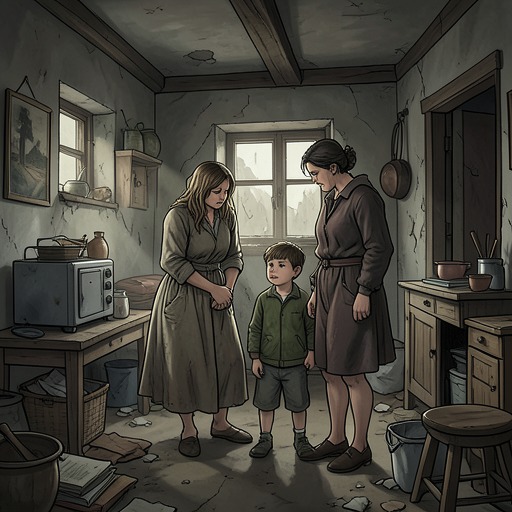
Georges’s death does not leave behind a substantial estate. M. Gillenormand has his sword and uniform sold to a secondhand dealer; neighbors strip the garden of its rare flowers, and the remaining plants become briars and die. The fading of the house and garden contrasts with the persistence of the scrap of paper. Material signs of the colonel’s former life disappear, while his account of Waterloo and his instructions remain available to Marius.
Georges is therefore present in the story largely through absence: the father removed from his son, the man who dies just before their meeting, and the soldier whose wounds Marius can read only on a dead body. The letter gives that absence an afterlife. It conveys the political injury of a title denied, records the paternal hope that Marius will be worthy of it, and places gratitude to Thénardier among the obligations Georges wished to pass on. His influence begins, for Marius, at the moment when direct conversation has become impossible.